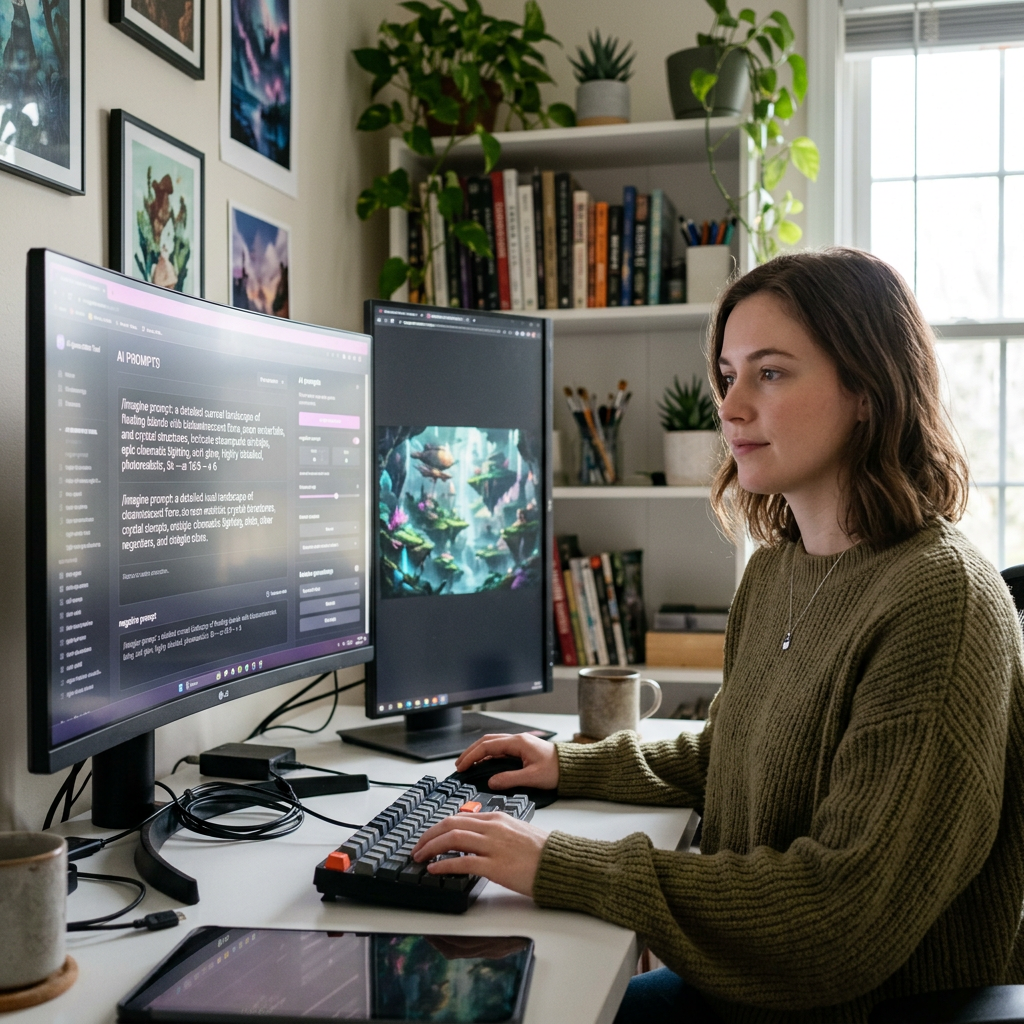
Artificial intelligence has changed the way people create. From images and illustrations to writing, music, branding, fashion concepts, and digital experiences, AI can now transform an idea expressed in words into an almost immediate creative output.

If artificial intelligence generates the output, can the person prompting it still be considered the creator?
The answer becomes much clearer when we stop thinking about creativity as simply the act of physically producing the final object. Creativity has always involved something deeper: having a vision, making choices, directing a process, recognizing what works, rejecting what does not, and refining an idea until it expresses something intentional.
A useful way to describe the proccess is:
- Expressive design + selection + refinement = authorship
AI may generate the individual output, but the creator can establish the concept, visual direction, aesthetic language, and constraints, mood, composition, and desired result. The creator then evaluates what the system produces, selects among possibilities, and continues refining the work.

In this sense, AI does not necessarily eliminate the creator. It can become another instrument through which the creator expresses an idea.
What Does It Mean to Be a Creator?
The traditional image of a creator is someone physically making something from beginning to end. But creative authorship has never depended entirely on physical labor. Why? Because authorship can involve creative direction and intentional decision-making.
The creator establishes what the work is supposed to communicate and makes choices that move the project toward that vision. AI introduces another version of this relationship. Instead of physically producing every component, a creator can describe an intended result, experiment with possibilities, evaluate the outputs, and progressively guide the system toward a particular creative expressions. This process can itself be creative.

AI Prompting is More Than Giving Instructions
It’s easy to think of prompting as simply asking an AI tool to ‘make something.” Consider a developed creative brief:
“Create an editorial fashion portrait inspired by early autumn, using a sophisticated palette of burgundy, cream, muted olive, and warm brown. Use dramatic directional lighting, a minimalist architectural background, subtle film texture, and an elegant high-fashion magazine composition. The mood should feel intellectual, refined, and slightly mysterious.”
This prompt becomes a form of expressive design. The creator is describing a desired experience.
Stay tuned for more on this topic. Subscribe to our blog to stay up-to-date with the most recent posts.



Leave a Reply